Drainage Grates& Covers
Browse our complete collection of drainage grates from leading manufacturers. From lightweight residential polymer grates to Class F airport-rated ductile iron, find the right solution for any load requirement and environment.
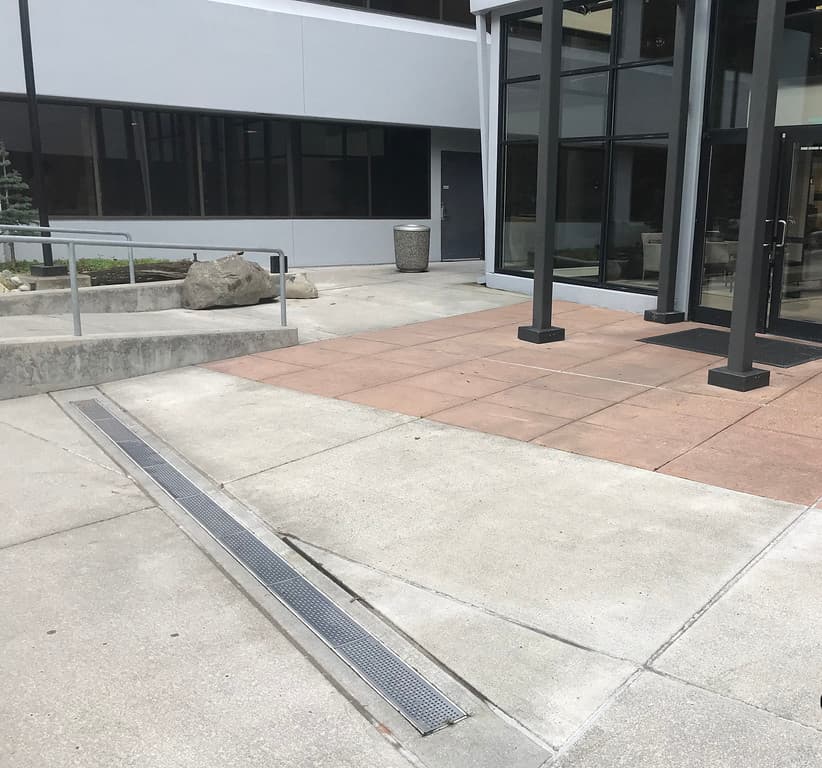
Installed steel ADA grate in a commercial pedestrian area
Load Class Quick Reference
EN 1433 classes (A15–F900) with AASHTO H-20/HS-20 equivalents
Common Grate Sizes in Inches & Millimeters
Grates are ordered by the clear opening of the frame or channel they sit in, and the same size carries two names depending on the market: a 12" trench grate is a 300 mm grate, and a 24" × 24" catch basin grate is a 600 × 600. The charts below map the sizes stocked in North America to their metric callouts.
Trench & Channel Grate Widths
| Width | Metric | Typical Lengths | Typical Duty |
|---|---|---|---|
| 2" | 50 mm | 20" (500 mm) | Patios, thresholds, shower & pool copings |
| 4" | 100 mm | 20" (500 mm) · 40" (1 m) | Driveways, sidewalks — the most common residential width |
| 5" | 125 mm | 20" (500 mm) · 40" (1 m) | Commercial walkways and hardscape |
| 6" | 150 mm | 20" (500 mm) · 40" (1 m) | Parking lots, car washes, light industrial |
| 8" | 200 mm | 20" (500 mm) · 40" (1 m) | Heavy commercial pavement, loading docks |
| 12" | 300 mm | 40" (1 m) — sold as "1000×300" | High-flow industrial yards and roadways |
Width refers to the nominal channel size; the grate itself is cut to seat inside that channel's frame, so exact grate dimensions vary by manufacturer.
Catch Basin & Storm Drain Grate Sizes
| Nominal Size | Metric | Typical Use |
|---|---|---|
| 9" × 9" | 229 × 229 mm | Yard and downspout basins |
| 12" × 12" | 305 × 305 mm | Residential catch basins, landscape drains |
| 18" × 18" | 457 × 457 mm | Commercial parking and landscape mains |
| 24" × 24" | 610 × 610 mm | Municipal storm inlets, street-rated duty |
| 30" × 30" | 762 × 762 mm | Large storm structures and area inlets |
| 24" round | 610 mm dia. | Round risers and basin covers, flat or beehive |
Square and round grates in these sizes are made in every material on this page—from polymer atop plastic basins to street-rated ductile iron in cast frames.
Metric Grate Callouts, Converted
Spec sheets and overseas drawings list grates in millimeters, length first. If you were handed a metric size, this is what it means in inches (divide any millimeter figure by 25.4 to convert):
| Metric Callout (mm) | Inches | What It Is |
|---|---|---|
| 500 × 100 | 19.7" × 3.9" | Half-meter grate section for a 100 mm (4") channel |
| 1000 × 300 | 39.4" × 11.8" | One-meter grate for a 300 mm (nominal 12") trench channel |
| 960 × 600 | 37.8" × 23.6" | Large rectangular gully/inlet grate; closest US frame is 36" × 24" — verify the clear opening before substituting |
| 600 × 600 | 23.6" × 23.6" | Metric counterpart of the 24" × 24" catch basin grate |
| 400 × 400 | 15.7" × 15.7" | Falls between US 12" and 18" square grates — measure the frame, not the old grate |
Before You Order: Three Measurements
- Clear opening— the inside of the frame where the grate seats, not the old grate's outside edge.
- Overall grate size— grates bear on a ledge, so their overall dimensions run larger than the clear opening; record both.
- Grate thickness— the seat depth of the frame must match so the replacement sits flush with the pavement.
Grate Specifications
Overview of drainage grate options, materials, and configurations. Specific specifications vary by manufacturer and model.
Grate Material Options
Different materials offer distinct advantages for durability, corrosion resistance, aesthetics, and load capacity. Select based on your specific application requirements.
Cast Iron Grates
Traditional material offering excellent compressive strength and durability. Gray iron grates are cost-effective for moderate loads while ductile iron handles heavy-duty applications. Available in countless patterns from historic restoration to modern designs.
Municipal infrastructure, historic districts, standard catch basins, moderate traffic
Stainless Steel Grates
Premium corrosion resistance for sanitary and corrosive environments. 304 stainless handles most applications; 316 stainless required for marine or heavy chemical exposure. Polished finishes provide attractive appearance for visible installations.
Food service, pools, coastal areas, chemical exposure, premium aesthetics
Galvanized Steel Grates
Carbon steel with zinc coating provides good corrosion resistance at lower cost than stainless. Strong and lightweight compared to iron. Galvanizing protects cut edges and fastener holes. Excellent choice for most commercial applications.
Commercial trench drains, warehouses, light industrial, cost-conscious projects
Polymer & Plastic Grates
Lightweight, corrosion-proof options for residential and light commercial use. Modern engineering polymers offer surprising strength while being easy to handle and install. Available in multiple colors to match surroundings.
Residential drainage, landscapes, pool decks, pedestrian areas, DIY installations
Decorative & Architectural Grates
Architectural patterns including lattice, scroll, wave, geometric, and custom designs in iron, bronze, and aluminum. Many architectural grates carry vehicle load ratings while providing visual appeal, and custom logos are available for municipal branding.
Streetscapes, plazas, municipal projects, historic preservation, branding
Tree Grates
Specialized grates designed to surround tree trunks in paved areas. Protect root zones while providing stable walking surfaces. Expandable centers accommodate tree growth. Available in numerous decorative patterns.
Urban forestry, streetscapes, parking lots, commercial landscapes
Cast Iron vs. Ductile vs. Steel vs. Stainless vs. Polymer
The material decides how a grate ages, what it costs, and how much traffic it can take. Use this comparison to shortlist, then confirm the certified load class of the specific pattern you order.
| Material | Relative Cost | Corrosion Resistance | Typical Load Range | Weight | Where It Wins |
|---|---|---|---|---|---|
| Gray cast iron | $$ | Moderate — forms a stable surface patina | A15–D400 | Heavy | Municipal streets, standard catch basins, historic districts |
| Ductile iron | $$$ | Moderate — same chemistry as gray iron, far tougher structure | C250–F900 | Heavy | Highways, loading docks, airports — impact and truck traffic |
| Galvanized steel | $$ | Good — zinc coating; avoid road salt and chemical exposure | A15–C250 typical | Medium | Commercial trench drains, warehouses, budget-driven projects |
| Stainless steel (304/316) | $$$$ | Excellent — specify 316 for chlorides, marine, and washdown chemicals | A15–C250 typical | Medium | Commercial kitchens, breweries, pools, coastal installations |
| Polymer / plastic | $ | Excellent — chemically inert, UV-stabilized options | A15–B125, select C250 | Light | Residential yards, pool decks, landscape drainage |
Load ranges are typical for each material; the pattern, bar depth, and frame determine the certified class. Exterior trench and channel grates are commonly rated under EN 1433, while interior floor drain grates fall under ASME A112.6.3 — always verify the marking on the product you specify.
Key Features
Common Applications
ADA-Compliant & Heel-Proof Grates
The 2010 ADA Standards for Accessible Design put hard limits on grate openings along accessible routes. Section 302.3 comes down to two rules — and both are about the opening, not the material.
The 1/2-Inch Sphere Rule
Openings in a walking surface may not allow passage of a sphere larger than 1/2" (13 mm). The rule governs slot width, not length—a 1/2" × 6" slot complies, while a 5/8" square hole does not.
Perpendicular Orientation
Elongated openings must run with their long dimension perpendicular to the dominant direction of travel, so wheelchair casters, cane tips, and bicycle tires cross the slots instead of tracking into them. On a sidewalk trench drain, that means slots aligned across the walkway, not along it.
The trade-off: narrower openings mean less open area, so a heel-proof pattern takes in water more slowly than a standard slotted grate of the same size. Compensate with a longer grate run, a wider channel, or a higher-intake perforated pattern rather than widening the slots.
Slot Width Quick Reference
| Opening Width | Rating | Where to Use It |
|---|---|---|
| ≤ 5/16" (8 mm) | Heel-proof | Pool decks, transit platforms, plazas with heavy foot traffic |
| ≤ 1/2" (13 mm) | ADA maximum — 2010 Standards §302.3 | Any accessible route: sidewalks, curb ramps, accessible parking |
| > 1/2" (13 mm) | Not permitted on accessible routes | Vehicular-only pavement, fenced industrial yards |
Heel-proof and ADA slotted patterns are stocked in cast iron, ductile iron, stainless steel, and polymer—so meeting the standard never forces a material compromise.
Grate Manufacturers
We partner with industry-leading foundries and manufacturers to offer drainage grates for every application and budget.
US Foundry
Cast iron and ductile iron grates
Neenah Foundry
Municipal-grade inlet grates and frames
NDS Grates
Polymer and plastic grates for residential/commercial
ACO Surface Water Management
Stainless steel and polymer concrete grates
Josam Cast Iron Drainage
Commercial floor drain grates and covers
A grate is only one part of the inlet—most pair with a catch basin or sit atop a trench drain channel. Not sure which load class you need? Review our load rating guide before specifying.
Grates by Application
Match grate material and load class to the demands of these environments.
Drainage Grate FAQs
Common questions about grate materials, load ratings, and selection
Drainage grate load ratings follow EN 1433 numeric classes, which the US market cross-references with AASHTO H-20/HS-20 truck loadings: A15 (~3,372 lb) is pedestrian, plaza, and sidewalk duty. B125 (~28,100 lb) covers walkways and light-vehicle parking. C250 (~56,200 lb, roughly AASHTO H-20) suits car and light-truck parking lots. D400 (~89,900 lb, roughly AASHTO HS-20/H-25) handles roadways, forklifts, and loading docks. E600 (~134,900 lb, roughly HS-25) is for industrial yards and docks. F900 (~202,300 lb) is airport apron and port duty. Always select a class that exceeds your actual wheel loads.
They are all drainage grates, but they fit different structures. A storm drain grate (also called a storm drain cover or inlet grate) caps a curb or area inlet that feeds a municipal or site storm sewer and is usually cast iron or ductile iron rated for vehicle traffic. A catch basin grate is round or square and sits over a sump that traps sediment before the outlet pipe. A trench drain grate (channel grate) is a long, narrow cover that runs the length of a linear channel. When ordering a replacement, measure the inside frame opening and match the grate type, size, and load class to your existing structure.
Cast iron (gray iron) is more brittle and prone to cracking under impact but is less expensive and adequate for lighter loads. Ductile iron contains nodular graphite that makes it more flexible, impact-resistant, and able to deform without fracturing. Ductile iron has 2-3x the tensile strength of gray iron and is required for heavy-traffic applications. For Class C and above load ratings, ductile iron is strongly recommended.
Stainless steel grates are essential in corrosive environments: food processing facilities, commercial kitchens, breweries, pools, coastal areas, and anywhere exposed to chemicals or salt. They also provide a premium appearance for visible installations. The higher upfront cost is offset by dramatically longer service life—stainless won't rust, corrode, or require replacement like carbon steel or iron grates in harsh conditions.
Section 302.3 of the 2010 ADA Standards for Accessible Design sets two rules for grates in walking surfaces: openings may not allow passage of a sphere larger than 1/2 inch (13 mm), and elongated openings must be placed with the long dimension perpendicular to the dominant direction of travel. In practice, any grate on an accessible route—sidewalk, plaza, curb ramp, accessible parking—needs slot widths of 1/2 inch or less regardless of orientation. Heel-proof grates go further, typically 5/16 inch (8 mm) or narrower, to keep narrow heels, cane tips, and bicycle tires from catching.
Those are metric callouts in millimeters, listed length first. A 1000x300 grate measures 39.4" x 11.8"—a one-meter trench grate section for a nominal 300 mm (12") channel. A 960x600 grate measures 37.8" x 23.6", a large rectangular gully or inlet grate; the closest common US frame is 36" x 24" (914 x 610 mm), but the two are not drop-in interchangeable, so always match the clear opening of your existing frame. To convert any metric grate size, divide the millimeter dimension by 25.4 to get inches.
Measure the inside dimensions of the frame or basin opening—this is the seated grate size. Common sizes include 6", 9", 12", 18", and 24" for catch basins, and standard widths for trench drains. Also measure frame depth if replacing both frame and grate. When possible, identify the manufacturer and model number of your existing system, as grates are designed to fit specific frames and may not be interchangeable between brands.
Open area percentage determines water intake capacity: Slotted grates (60-70% open) provide maximum intake but may not be heel-safe. Perforated grates (40-50% open) balance intake with heel safety. Bar grates offer high structural strength with moderate intake. Lattice/grid patterns combine aesthetics with functional drainage. For high-flow applications, specify grates with the highest open area that still meets your load and safety requirements.
Locking grates are recommended or required for: public areas where theft or tampering is a concern, safety-critical locations like playgrounds or schools, traffic areas where vibration could dislodge grates, and anywhere unauthorized access to the drainage system must be prevented. Locking mechanisms include bolt-down hardware, hinged frames with locks, and specialty tamper-resistant fasteners.
Tree grates are decorative grates installed around the base of trees in urban environments. They protect tree roots from foot traffic and compaction, allow water and air to reach the root zone, provide a stable walking surface, and enhance streetscape aesthetics. Tree grates come in various patterns (concentric rings, radial designs, custom logos) and can include expandable centers to accommodate tree growth.
Grate rattle occurs when grates aren't properly seated in frames. Solutions include: using rubber gaskets or neoprene strips between grate and frame, ensuring frames are installed level and true, selecting grates designed with noise-reducing features (machined bearing surfaces, tight tolerances), using bolt-down or wedge-lock systems to secure grates, and specifying solid-top frames where high traffic is expected.
Many decorative grate patterns are available in load-rated versions suitable for vehicle traffic. However, intricate patterns may have lower structural strength than simple bar or slot designs. When specifying decorative grates for traffic areas, always verify the load rating meets your requirements. For heavy-duty applications, consider using decorative patterns only in pedestrian areas and functional designs in drive lanes.
Resources & Tools
Technical documentation, load rating guides, and material specifications
Load Rating Guide
Understanding AASHTO load classifications
ADA Compliance Requirements
Accessibility standards for drainage grates
Material Selection Guide
Choosing the right grate material for your application
Grate Pattern Comparison
Open area, strength, and application guide
Shop Drainage Grates
Browse our complete grate selection
Need Help Selecting the Right Grate?
Our specialists can help you choose the right material, load rating, and pattern for your specific application requirements.